Sunday, September 9, 2007

History of Caves Branch Botanical Garden

Some orchids described as exotic, extravagant, with liverish leaves and flamboyant, menacing blooms. Others symbolize elegance, quiet, unassuming beauty and tranquility.
Gongora Unicolor
Maxillaria tenuifolia
Catasetum intergerrimum
Trigonidium Egertonianum
Orchids are the world's most diverse plant family with the number of species estimated to be between 30,000 to 40,000 in over 800 genera. We have approximately 70 different species among our collection of more than 800 orchids in our garden. There are many more orchids and bromeliads at the lodge grounds that we continue discovering in it's natural habitat.

Our botanical garden was started with the collection that was purchased from Mrs. Ana D'Silva. It was her passion of 30 years to collect those plants and take care of them. Those orchids were part of her family, she could feel their needs, talked to them and loved them dearly. We became passionately involved with her plants as well, and since November 2006 almost doubled the original collection.

Some of the orchids will surprise you by it's astonishing shape, colour, texture and incredible perfume that will vary depending on the time of the day or night. Some of them are so delicate that you need to have a magnifying glass to see them, and some of them will be captivating because of the variety of the pollinators that will be visiting them. You will be surprised to witness how these flowers manipulate, connive, court, seduce and deceive insects into having getting pollinated.

We carefully study our collection and continue identifying species that we have under the experienced leadership of our Head Gardener, Jobito Santos Chan.
Many years ago Mr. Chan studied Organic Agriculture Indigenous Solution for a Sustainable Future in Santa Fe, USA . Because of his expertize we abstain from the use of any agro chemicals to treat plants and orchids. He uses natural herbs and remedies to combat plants diseases and harmful insects.
Mr. Chan is always willing to share what he knows about the local orchids and plants and you can stop by the orchid garden any time of the day. If you'll come in the heat of the day he will show you the beauty of the collection in it's full flamboyant colors, and advise to stop by later in the day to experience the magnificent scents coming from the orchids when the sun is gone. Real adventure in the world of orchids.. Adventure that must be experienced to be believed...But once experienced, Never Forgotten!


Caves Branch Orchids

Black Orchid , National Flower of Belize
Scientific name: Encyclia CochleatumSpiranthes sceptrodes
Trigonidium EgertonianumVanda Ms. Joaquim
Vanda
Zygopetalum mackaii
Oncidium Altissimum
Ornithocephalus gladiatus Phalaenopsis
Pleurotballis mirabilis
Spathoglottis Unguiculata.?.
Maxillaria tenuifolia
Mormolica Ringens
Nidema boothii
Oncicium ascendeus
Ionopsis utricularioides
Ludicia Discolor
Lycaste aromatica
Maxillaria densaMaxillaria Rufescens Epidendrum StamfordianiumEpidendrum hawkesii
Epidendrum imatophyllum
Epidendrum nocturnum
Gongora unicolor
Encyclia atropurpurea
Dichaea panamensis
Rhyncholaelia digbyana
Epidendrum Ciliare
Cattleya
Coelia bella
Encyclia Alata
Brassavola Nodosa
Brassia Caudata

Insects and other creatures of Caves Branch

Orchids have evolved a vast range of blandishments to attract, entrap and manipulate. Some of them developed flowers that disguised as insects and simulate their movements, rocking gently on exquisitely balanced hinges.
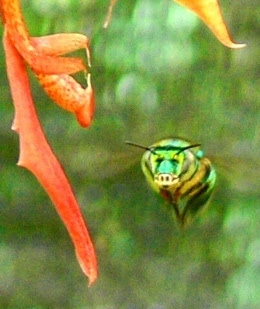
While watching for pollinators we come across a variety of other insects that effect the well-being of our orchids and plants surrounding them. Meet them face to face.


Orchid Facts and Historical Info

Have you ever had Orchid ice cream ?
Salepi dondurma, Turkish ice cream, made from dried orchid tuber, flour, sugar and cinnamon was first made in the 16th century. How does it taste? Eric Hansen, the author of the "Orchid fever", traveled to Turkey to witness the process of making that ice cream and tasted it freshly made: "The cold, silky orbs held the familiar flavors of apricot, pistachio, red currant, peach, vanilla, and bilberry, but there was a subtle aftertaste that I could not identify - slightly sweet with a subtle nutty flavor similar to dried milk powder. It also had a hint of mushrooms, yak butter, and the smell of a got on a rainy day. Not unpleasant, but an earthy, lanolin fragrance that added an intriguing dimensions to the ice cream as it slowly melted in my mouth."

What is the World's Smallest Orchid?
The smallest orchid is Platystele jungermannioides, which has flowers only half a millimeter or one-hundredth of an inch in diameter. The entire plant is only about a quarter of an inch tall. They grow naturally in the cloud forests in Central America. The flower, when viewed through a magnifying glass , is a pale greenish color with a purple lip.

What is the World's tallest Orchid?
The tallest freestanding orchid is Sobralia Altissima from the high forests of Peru. It is reported to grow up to 44 feet high. The bright reddish-purple flowers are up to 6 inches across.

What is the Wolrd's Largest Orchid?
The largest orchid is Grammatophyllum Speciosum. It can weigh up to 2,000 pounds and is reputed to produce up to 10, 000 flowers on a mature plant. The pseudo bulbs reach 10 feet in height with leaves along the full length. This monster of an orchid is often found growing as an epiphyte high above the ground on rain forest trees, and more than one collector has been maimed or crushed to death on the jungle floor while trying to dislodge this particular species.

The scent of an Orchid

The warrior/philosopher Confucius (551-479 b.c) called the orchid "the king of fragrant plants." The popularity of fragrant orchids eventually spread to Japan, and by the early 17th century samurai started cultivating Neofinetia falcatas for it's fascinating scent, while the members of the Japanese royalty were perfuming their clothes with Dendrobium moniliforme.

How do you smell an orchid?

In the book Orchid Fever there is an advice given by a Japanese perfumer:

" You have to smell through the first thing that hits your nose, because this is usually the lighter aspect, often a lemony point. It is the most volatile component. The different notes or aspect reveal themselves in stages, and you have to smell through them to get to the bottom of the fragrance puzzle. There are top, middle, and base notes, and that is how we describe fragrances. The base notes are the least volatile and they come up last." Using this technique, he further describes the scent of Cymbidium linearisepalum : Well, here the first thing that hits you is not a citrus note, but jasmine..jasmine album. A very light, extremely elegant jasmine note. And right after that it goes into lily-of-the -valley, which is very fresh. Not citrusy fresh, but a fresh floral scent. I also smell apple blossoms, and now here is something interesting. There is a note that remind me of peaches.Yes, fresh peaches, slightly warmed in the sun."


Reference Materials

Orchid Fever by Eric Hansen. A horticultural Tale of Love, Lust and Lunacy. Incredible book!

Native Orchids of Belize by I. McLeish, N.R. Pearce @ B.R. Adams.

Orchids from the Archives of the Royal Horticultural Society by Mark Griffiths